West London Inclusive Arts Festival Celebrates 10 Years of Accessible Arts Opportunities for d/Deaf, Disabled and Neurodivergent Young People 

The West London Inclusive Arts Festival (WLIAF) is celebrating its 10th anniversary, recognising a decade of championing access, creativity and collaboration for children and young people with special educational needs and disabilities (SEND). The milestone will be marked with the festivals’ annual two-day celebration on Tuesday 19–Wednesday 20 May, where talented disabled young people from across west London will perform at the Royal Albert Hall – many for the very first time.  

After ten years of positively impacting over 6,000 young people with SEND, WLIAF is using its celebration of young people’s achievements to encourage other cultural institutions across London and beyond to be actively more inclusive. Their aim is to continue to build an inclusive cultural eco-system in London. Working across schools, families, cultural organisations, disable led and disable focused arts organisations.  London has the highest concentration of cultural institutions in England, we should be the centre of best practice  

What began as a small partnership between two schools and John Lyon’s Charity has grown into a dynamic, cross-borough initiative uniting seven special schools across five London boroughs increasing its reach and its ambition. The festival works in partnership with leading cultural organisations including the Royal Albert Hall, Graeae Theatre Company, ActionSpace and the Tri-borough Music Hub, with ten years of support from John Lyon’s Charity. 

WLIAF was created to address the barriers that too often prevent d/Deaf, disabled and neurodivergent young people from accessing arts and culture. By bringing schools and cultural institutions together, the festival demonstrates how inclusive, high-quality creative opportunities can be embedded and sustained. 

Paul Morrow, Director of the West London Inclusive Arts Festival, said: “WLIAF shows what can happen when schools, families and cultural institutions work together with a shared commitment to inclusion. This isn’t just about creating opportunities – it’s about reshaping the system so that young people with SEND are recognised as artists, performers and cultural contributors in their own right.” 

Over the past decade, the festival has evolved into a year-round, inclusive programme shaped by the needs of schools, students and families – creating vital opportunities to build relationships, identify barriers and drive more inclusive practice across the cultural sector. Now entering its second decade, WLIAF is focused on strengthening its role as a connector across London’s cultural landscape. 

One of last year’s talented performers said: “The performance that I did was called the Path Unseen. It was a movement, not a dance and after the movement we read a poem about explorers. I feel happy and I feel really special that I had this opportunity to come here and I am really glad to tell the people in the future time.” 

At its core, WLIAF is about more than access to the arts – it is about equity, visibility and the right for every young person to feel welcome in cultural spaces. For many disabled young people and their families, barriers to participation still exist, whether physical, systemic or attitudinal. By working in partnership with schools, families and cultural institutions, WLIAF has developed a model of inclusive practice that is both effective and replicable. It shows that with the right approach, cultural spaces can become accessible, welcoming and safe for all. 

As the festival looks ahead, it is calling on organisations across London and beyond to take forward this learning – embedding inclusion into their everyday practice and ensuring that all young people, regardless of need, have the opportunity to engage with, and shape, the arts. To find out more about West London Inclusive Arts Festival, please click here

YPF Trust and Henry Smith Foundation launch £3m Core Memories Fund

At 18, the support stops. For young people who are care-experienced, excluded from school, LGBT+, or living with learning disabilities, that moment can arrive across several systems at once. Since 2010, youth services have been cut by 76 to 80% in some parts of England. What remains is fragmented, short term, and organised around crisis rather than potential.

Core Memories backs organisations that show up at the moment statutory support steps away. It starts with a different question. Not: what has gone wrong? But: what helps young people thrive? Research on Positive Childhood Experiences shows that access to a trusted adult, a sense of belonging, and a genuine say in decisions are not extras. They are the conditions that protect young people and build independence over time. Yet funding has long required organisations to evidence damage before support arrives. Core Memories invests before the crisis, not after.

The fund commits £3 million over three years, delivered through YPF Trust’s network of place-based Young People’s Foundations. Grants of between £5,000 and £25,000 will reach an estimated 170 to 513 grassroots organisations across six areas: Merton, Dorset, Kirklees, Stockton-on-Tees, Medway, and Staffordshire. A youth worker who knows your name. Access to sport, arts, community. A place where you belong before things fall apart. Core Memories funds organisations doing exactly that work, in the places where it’s needed most.

The model builds on work pioneered by John Lyon’s Charity, which established the first Young People’s Foundation in Brent in 2014. YPF Trust was created in 2019 to take that model national. The network now spans nearly 70 foundations across England.

Chris Murray, CEO of YPF Trust, said: “We are thrilled to partner with the Henry Smith Foundation at such a pivotal time. Their commitment to long‑term, flexible funding and their focus on youth advocacy and independence will allow us to deepen our Core Memories work and reach even more young people navigating complex transitions. This investment strengthens the sector and, more importantly, strengthens the young people at its heart.”

Ghino Parker, Director – Building Independence at Henry Smith Foundation, said: “For too long, funding for young people has been built around what they lack. Core Memories asks a different question: what do they need to thrive? A trusted adult. Somewhere they belong. A real say in their own lives. The Henry Smith Foundation is backing this fund because we know these things are not peripheral – they are the foundation of an independent life.”

For more information about the Core Memories Fund, please visit www.YPFTrust.org.uk.

Changes to John Lyon’s Charity Grantmaking Process

For many years, the Charity’s grantmaking has been considered by the Grants Committee and approved by the Foundation Governors (the Trustee) at three meetings each year, held in March, June and November.

Following a review of the Charity’s approval process, from 1 April 2026 John Lyon’s Charity will move to two committee meetings per year, held in June and November. This change is intended to streamline the grantmaking process and enable decisions to be made more efficiently throughout the year. Under the new approach, smaller grant requests will be considered and approved on a rolling basis, while larger grant requests will continue to be discussed at the two annual committee meetings.

This decision has been made following careful consideration and aims to ensure the Charity’s grantmaking process remains responsive and effective. If you have any questions about this change, please contact your Grants Manager or email [email protected].  For current information about application deadlines, please click here.

Our Response to the Special Educational Needs and Disabilities Reform

Last week the government published its long-awaited white paper on reforms to the Special Educational Needs and Disabilities (SEND) system – a development closely watched by families, schools, voluntary organisations and funders across the country.

At John Lyon’s Charity, we have seen first-hand the growing pressure on the current system. In our Beneficial Area alone, the number of Education, Health and Care Plans (EHCPs) has more than doubled in the past five years, reflecting rising levels of need and a system stretched beyond its capacity. Many of the organisations we fund, including those supporting families through assessments and appeals, know how complex and emotionally demanding the process can be.

The government’s proposals include a greater emphasis on early identification and early intervention, increased support for schools through specialist expertise, and a move away from EHCPs for many children towards new Individual Support Plans (ISPs). While these changes offer potential opportunities, they also raise important questions for families, schools and community organisations.

In our latest blog, we explore what these proposals could mean in practice – from the opportunities presented by earlier support and improved specialist advice, to concerns around pressure on schools, the role of community organisations, and how key transitions for young people with SEND will be supported.

We also reflect on the importance of ensuring that reforms do not deepen existing inequalities, particularly for families who already face barriers in navigating the education system.

Read our full blog to explore the Charity’s perspective on the SEND reforms and what they could mean for children, families and the wider sector.

Young People’s Foundations mark a decade of impact with new telling report, as Government prepares new youth strategy 

In anticipation of the Government’s new Youth Strategy, a New Report Shows How Place-Based Investment in Young People Delivers Long-Term Value 

As the UK continues to face ongoing cost-of-living pressures, John Lyon’s Charity (JLC) launches a new report marking ten years of the pioneering Young People’s Foundations (YPFs) – a model that has helped protect vital youth services during a decade of rising demand and shrinking resources.  YPFs are borough-based infrastructure organisations that bring together organisations from the voluntary, private and public sectors to deliver collaborative work around children and youth services at a local level.  

Ten years ago, JLC created the YPF model to act as a critical stabiliser, helping grassroots organisations survive and scale at a time when many would otherwise have closed their doors.  

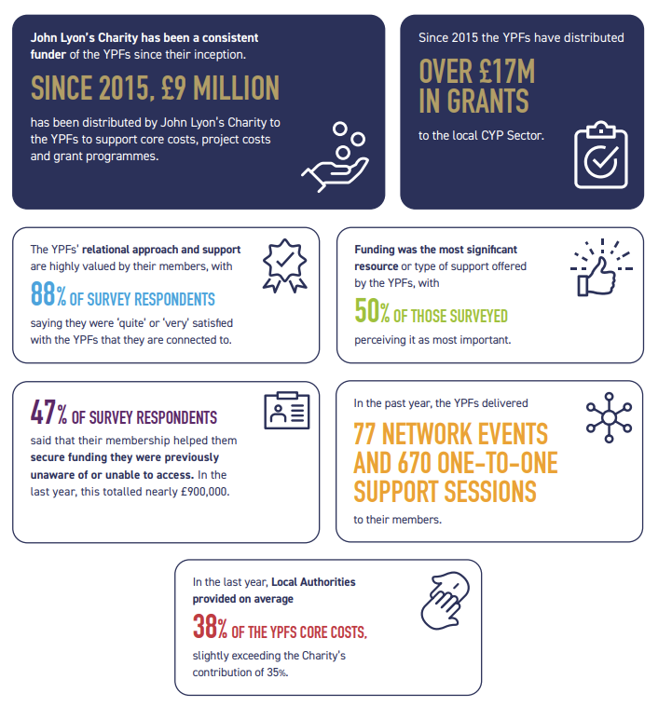
Over the past decade, John Lyon’s Charity has invested £9 million into the YPFs – funding that has sustained core costs such as salaries, driven forward projects by getting local charities and Local Authorities to work together and unlocked further funding at a time of intense financial pressure on both charities and local government. Crucially, Local Authorities now contribute 38% of YPFs’ core costs demonstrating the model’s long-term sustainability and its value as a cost-effective, partnership-led approach to youth investment.  Since 2015, these Foundations have distributed over £17 million in grants, supporting thousands of young people and strengthening grassroots organisations in a range of communities.   

Since their creation in 2015, YPFs have become a vital force for good, connecting the public, private and voluntary sectors to ensure young people have the support, opportunities and environments they deserve. Each YPF is shaped by the needs of its local community, but all share a powerful purpose: to unlock funding, open doors to further investment, and create networking opportunities with Local Authorities, charities, funders and the police. In doing so, they strengthen the sector, enhance its effectiveness, and ensure long-term sustainability. 

In the last financial year alone, YPFs in London have secured c.£1M in new investment for member organisations via collaborative bids and fundraising; delivered over 70 well-attended specialist network sessions, on topics such as youth violence, mental health, and SEND support; conducted 670 one-to-one support sessions; delivered training to upskill the sector on vital areas such as safeguarding and youth work; and established a pioneering “venue bank” to bring underused community assets back into use. Most importantly, they have bridged the gap between grassroots groups and Local Authorities, ensuring that smaller organisations are more visible, better connected and able to influence local decision-making. 

What began as a vision rooted in JLC’s Beneficial Area has now grown beyond London, with 24 YPFs across the country as well as seven further pending YPFs and many other Local Youth Partnerships, following a YPF-style mode.   

Lynne Guyton, CEO of John Lyon’s Charity, said: “The impact of the YPF model in London has been transformative, and we want to show how this type of funding model can be replicated. By creating simple, structured approaches, we can demonstrate to Government, funders, and the wider sector how a well-designed model can create real, life-changing impact for young people across the UK and beyond. The lessons learned here are invaluable for new foundations, proving that place-based, collaborative investment works.” 

Elly Heaton, CEO of Young Ealing Foundation said“The cost-of-living crisis is pushing more young people and families towards crisis point, just as funding for community organisations becomes more fragile. Without intervention, vital grassroots groups disappear and the cost to society is far greater. YPFs are proving that strategic, place-based support is cheaper than crisis response.” 

The YPF report offers a clear message: investing early in place-based, collaborative infrastructure for young people delivers both social impact and economic value. With continued investment and national recognition, the YPF movement has the potential to expand even further, giving every young person, wherever they live, the chance to reach their full potential. 

To access the YPF Report in full, please click here. If you would like to learn more about John Lyon’s Charity and the Young People’s Foundations, please click here.  

*Source from REVIEW OF YOUNG PEOPLE’S FOUNDATIONS IN THE CHARITY’S BENEFICIAL AREA – SUMMARY REPORT, Rocket Science.